
Mesh Router vs WiFi Extender vs Access Point: Which WiFi Solution is Best?
 Kapadia Infotech
Introduction
Weak WiFi signals, dead zones, unstable connections, and slow internet can destroy productivity and create daily frustration.
When looking for a solution, most people come across three common options:
- WiFi Extenders
- Mesh WiFi Systems
- Wireless Access Points
At first glance, they may seem similar. They all improve WiFi coverage.
But in reality, they work very differently—and choosing the wrong one can lead to wasted money, poor performance, and long-term frustration.
This guide breaks everything down clearly so you can confidently choose the right WiFi setup for your home, office, or business network.
What is a WiFi Extender?
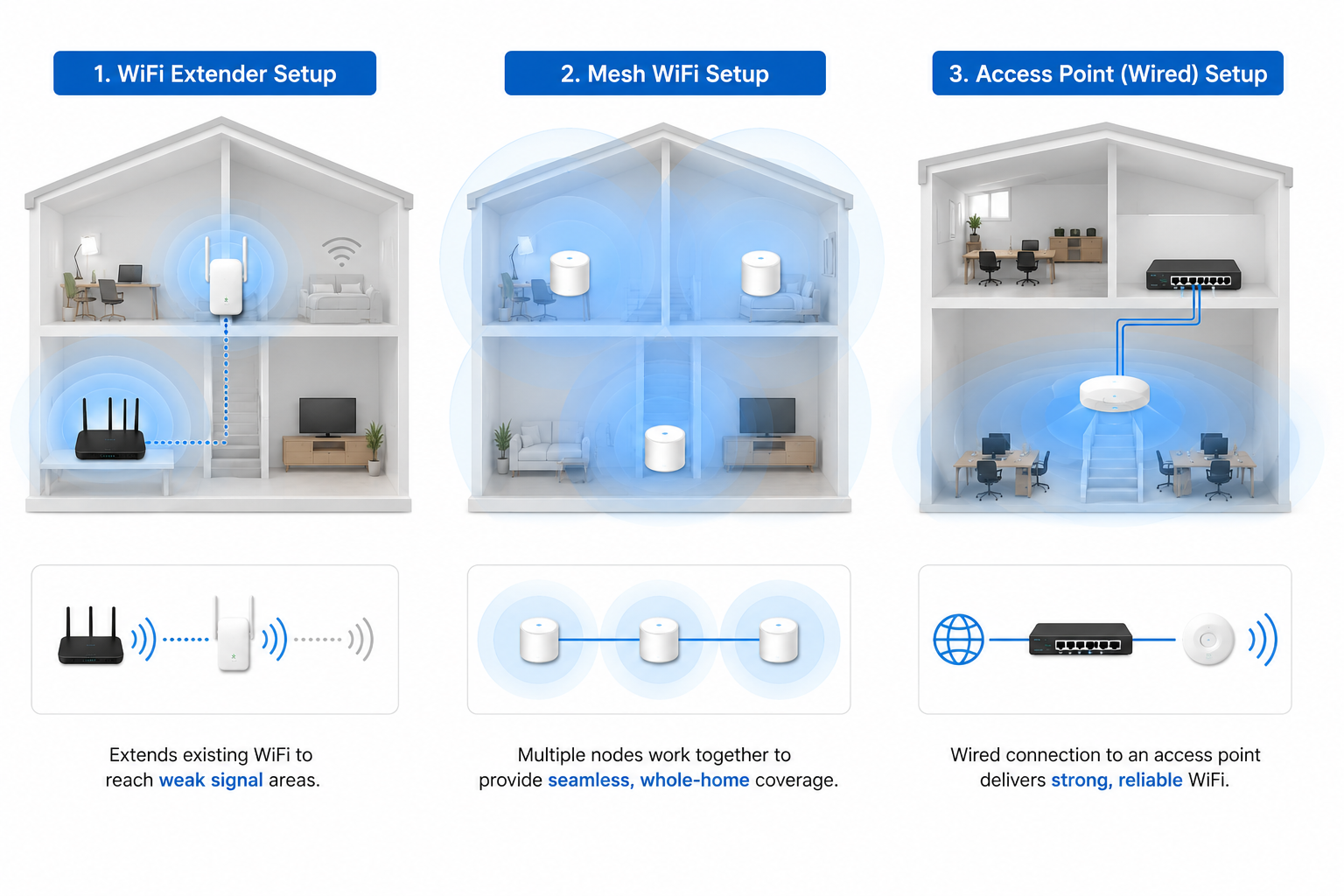
A WiFi extender receives your existing wireless signal and rebroadcasts it to expand coverage.
How It Works
Think of it like repeating a message. The extender hears your router and repeats the signal further.
Advantages
- Affordable
- Easy to install
- Good for small dead zones
Limitations
- Often cuts bandwidth significantly
- Higher latency
- Can create separate network names
- Performance drops with distance
Best for basic home usage—not ideal for professional environments.
What is Mesh WiFi?
A mesh WiFi system uses multiple intelligent nodes working together as one seamless network.
Unlike extenders, mesh nodes communicate intelligently and optimize traffic automatically.
Advantages
- Seamless roaming
- Better speed retention
- Whole-home or medium-office coverage
- Smart self-healing network
Limitations
- Higher cost than extenders
- Not always ideal for very large enterprise deployments
Perfect for premium homes and growing offices.
What is a Wireless Access Point?
A wireless access point connects directly to your network via Ethernet cable and broadcasts strong WiFi independently.
This is the standard solution for business-grade networking.
Advantages
- Maximum speed
- Excellent stability
- Supports high device density
- Centralized management
- Enterprise-grade security
Limitations
- Requires structured cabling
- Professional installation recommended
This is the best option for offices, schools, hospitals, and commercial environments.
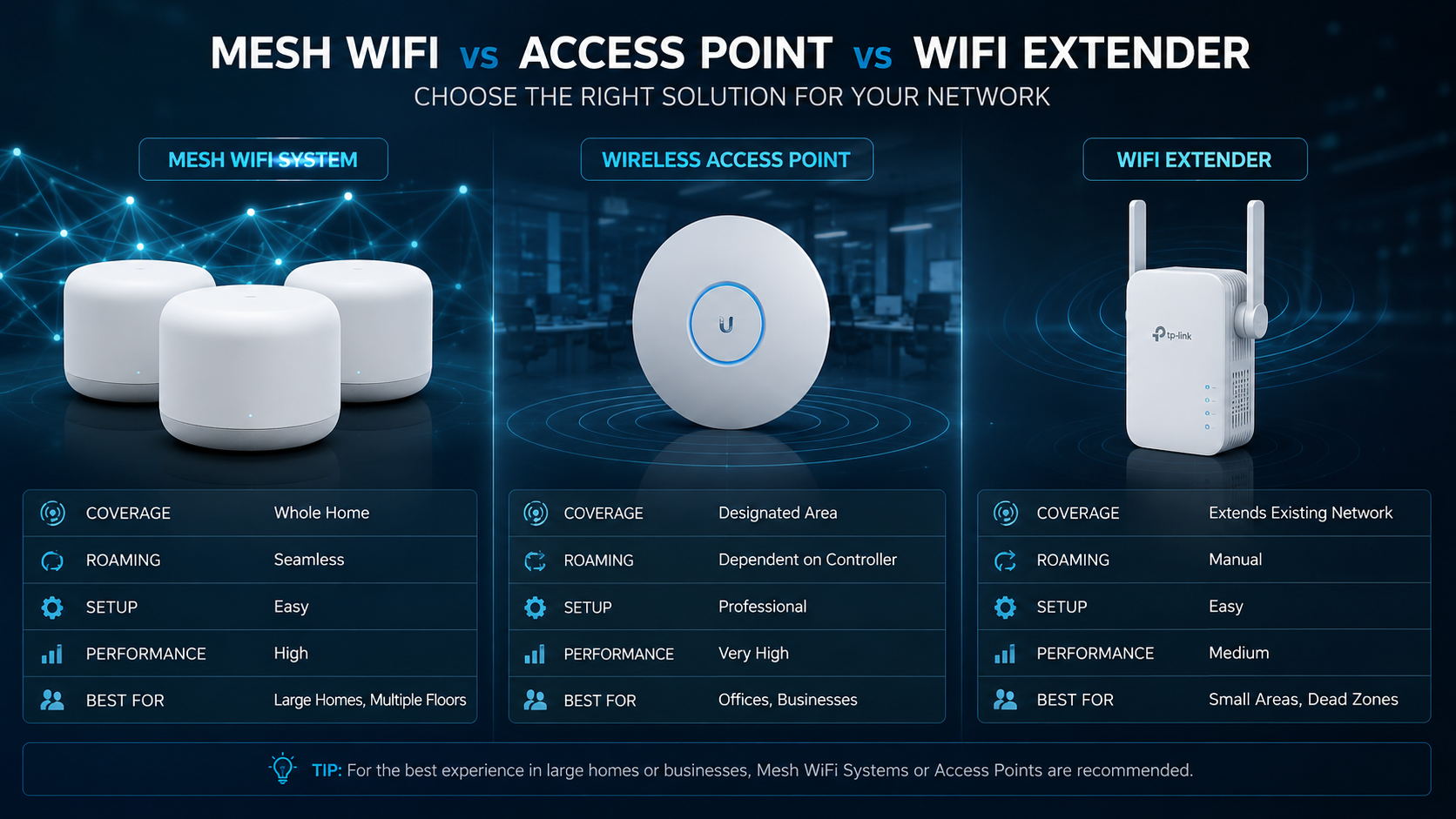
Mesh Router vs Extender vs Access Point: Side-by-Side Comparison
| Feature | WiFi Extender | Mesh WiFi | Access Point |
|---|---|---|---|
| Coverage Quality | Moderate | Excellent | Best |
| Speed Retention | Low | High | Maximum |
| Scalability | Limited | Good | Excellent |
| Installation Complexity | Easy | Moderate | Professional |
| Business Reliability | Weak | Good | Best |
| Cost | Low | Medium | Medium to High |
Which One Should You Choose?
Choose a WiFi Extender If:
- You need a quick low-cost fix
- Your dead zone is small
- You use basic internet browsing
Choose Mesh WiFi If:
- You want seamless coverage across home or office
- You need stable video calls and streaming
- You want modern smart network control
Choose Access Points If:
- You run a business network
- You need maximum reliability
- You support many users and devices
- You need enterprise security and scalability
Common Mistakes Buyers Make
- Buying extenders for large office spaces
- Ignoring structured cabling needs
- Choosing based only on price
- Not planning for future growth
- Using consumer routers in enterprise environments
Need Expert WiFi Planning?
Find the Right WiFi Solution for Your Space
Whether you need mesh WiFi, access points, or a complete enterprise network setup, we help design and deploy the right solution for performance, security, and future scalability.
Contact Kapadia InfotechFrequently Asked Questions
Yes. Mesh WiFi provides seamless coverage and better speed compared to traditional extenders.
For businesses and large deployments, yes. Access points offer better reliability, performance, and scalability.
For homes and small offices yes, but enterprise networks still benefit more from dedicated access points.
Most traditional extenders reduce available bandwidth because they repeat signals wirelessly.
Final Thoughts
There is no one-size-fits-all answer.
The right choice depends on your space, user count, performance expectations, and future scalability.
Choosing correctly now saves money, frustration, and costly upgrades later.