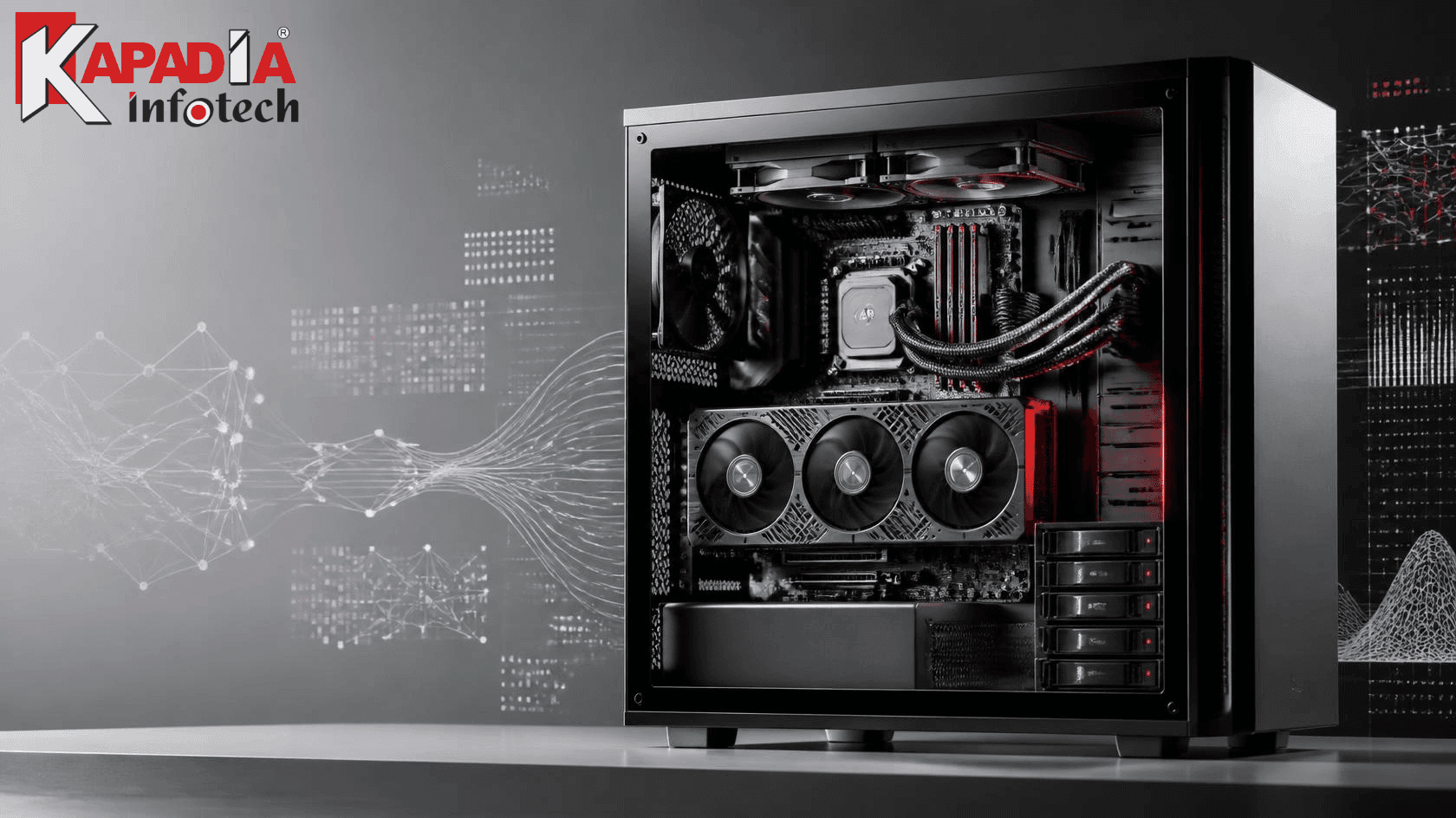
Why RAM and SSD Prices Are Increasing in 2026: AI Revolution & Chip Shortage
 Kapadia Infotech
Why RAM, SSD, and Chip-Level Component Prices Are Rising Due to the AI Revolution
Over the past year, many consumers, PC builders, and IT businesses have noticed a consistent increase in the prices of essential computer components such as RAM, SSDs, and other semiconductor-level parts. What once used to be affordable upgrades for laptops and desktops are now becoming significantly more expensive month after month.
The main reason behind this sudden price surge is the rapid global expansion of Artificial Intelligence (AI) infrastructure. Massive investments in AI data centers, combined with limited semiconductor manufacturing capacity, have created a supply imbalance that is affecting the global technology market—including India.
In simple terms, AI companies and cloud providers are consuming an enormous share of the world’s memory chips, leaving less supply for consumer devices such as PCs, laptops, and smartphones.
Let’s explore why RAM and SSD prices are rising and how the AI revolution is influencing the semiconductor supply chain.
The AI Boom Is Consuming Global Memory Supply
Artificial Intelligence has become one of the fastest-growing sectors in the technology industry. Major technology companies are investing billions of dollars to build large-scale AI infrastructure and data centers.
These AI systems require extremely powerful hardware, including GPUs, high-bandwidth memory, DRAM, and high-capacity storage solutions. Training large AI models requires massive datasets and huge amounts of memory bandwidth.
As a result, AI servers use significantly more memory than normal computing systems. Each AI server may require hundreds of gigabytes or even terabytes of memory to process machine learning workloads efficiently. This means that AI infrastructure is consuming a huge share of the world’s memory chip production.
Memory Manufacturers Are Prioritizing AI Hardware
Another key reason for rising RAM and SSD prices is the strategic shift in manufacturing priorities. Global memory manufacturers are focusing more on producing high-margin chips used in AI accelerators and data centers rather than standard consumer memory modules.
For example, companies are allocating production capacity toward:
- High-bandwidth memory (HBM)
- DDR5 server memory
- Enterprise-grade NAND storage
- AI-optimized semiconductor packages
This shift means that fewer manufacturing resources are being used to produce the traditional DRAM and NAND chips commonly used in laptops, desktops, and consumer SSDs.
As manufacturers prioritize AI infrastructure, the supply of consumer memory chips becomes limited. This reduced supply automatically drives up prices in the retail market.
Limited Semiconductor Manufacturing Capacity
The semiconductor industry is extremely complex and expensive. Building new fabrication plants (fabs) can cost tens of billions of dollars and take several years to complete.
Even though demand for memory chips is increasing rapidly, manufacturing capacity cannot scale overnight. Currently, only a few companies dominate the global memory market.
Because global DRAM production is controlled by a limited number of manufacturers, the supply chain becomes highly sensitive to demand fluctuations. When demand suddenly increases—such as during the AI boom—manufacturers cannot immediately increase production, resulting in supply shortages.
Rising Demand From Data Centers
AI development requires massive cloud infrastructure. Companies around the world are building thousands of new data centers to support machine learning workloads, generative AI models, and AI-powered applications.
These data centers rely heavily on:
- High-capacity SSD storage
- Large DRAM memory modules
- High-speed data processing hardware
This massive infrastructure expansion is causing a surge in demand for both DRAM and NAND memory chips. As hyperscale cloud companies purchase huge quantities of memory components, smaller markets such as consumer electronics and personal computers face limited availability.
Price Increases Across the Global Market
The result of this demand surge is a significant increase in memory prices across the entire technology industry.
Manufacturers are facing higher production costs, which often leads to increased retail prices for consumers. The impact of these price increases can already be seen in various devices, including:
- Laptops and desktops
- Smartphones
- Gaming PCs
- Enterprise servers
As AI infrastructure investments continue to grow, the demand for advanced memory solutions is expected to remain high, putting additional pressure on supply chains.
Impact on the Indian Technology Market
India heavily relies on imported semiconductor components because the country currently has limited large-scale semiconductor manufacturing capabilities.
This means the Indian market is particularly sensitive to global supply chain disruptions. When global RAM and SSD prices rise, Indian distributors and IT retailers experience increased procurement costs and limited inventory availability.
For IT service providers, system builders, and repair businesses in India, this means hardware upgrades and replacements are becoming more expensive for both businesses and individual customers.
The Beginning of a Memory Supercycle
Many analysts believe that the memory market has entered what is known as a “memory supercycle.” A supercycle occurs when demand for a technology grows much faster than supply for several years.
The current AI revolution is creating exactly that scenario. As AI continues to evolve, new models will require even larger datasets and more powerful hardware. This will further increase the demand for memory and storage components.
Industry forecasts suggest that tight supply conditions and elevated prices may continue until new semiconductor manufacturing facilities become operational and global production capacity expands.
What Consumers and Businesses Should Expect
For consumers and businesses, the rising cost of RAM, SSDs, and chip-level components may remain a reality for the next few years.
Some common trends that may continue include:
- Higher prices for RAM and SSD upgrades
- Limited availability of certain memory configurations
- Increasing cost of laptops and smartphones
- Reduced base storage or memory in budget devices
However, as semiconductor manufacturers expand their production capacity and new fabrication plants become operational, supply may eventually stabilize.
Conclusion
The increase in RAM, SSD, and chip-level component prices is not just a temporary market fluctuation—it is a direct consequence of the global AI revolution.
As companies race to build AI infrastructure, memory chips are becoming one of the most critical resources in modern computing. With limited manufacturing capacity and skyrocketing demand from AI data centers, the supply of consumer memory components has tightened significantly.
For markets that rely heavily on imported semiconductor components, these global supply pressures translate directly into higher hardware prices. Until new semiconductor manufacturing capacity comes online and the AI market stabilizes, rising RAM and SSD prices are likely to remain a major trend in the technology industry.